
For Grades 8–10 • CBSE & ICSE Science & Maths
Learn at Your Level. Understand. Apply. Grow.
Galigent is your AI-powered learning companion that helps you understand concepts, not just finish lessons. Ask questions, explore ideas, practice, and get guidance that adapts as you learn.
- Judgment-free, infinitely patient
- Built around your board syllabus
- Mastery
- Growing
- Concept by concept
- Misconceptions
- Spotted
- Mass vs weight
- Guidance
- Level 2
- Guided inferences
Aarav (Grade 9 student)
“Why does the gravitational force drop by 4 times if the distance is only doubled? Why is it r² instead of just r?”
Great question, Aarav! Imagine shining a flashlight at a wall from 1 meter. Now step back to 2 meters. The same beam of light now spreads out over both height and width.
Gravitational fields spread out in 3D. What do you think happens to the force if the distance triples?
- Force becomes 1/9th
- Show me a diagram
- Give me a hint
Adaptive Learning
Your Learning. Your Way.
Every student learns differently. Galigent adapts the learning experience to where you are—not where a rigid textbook expects you to be.
PATHWAY 01
Ask questions anytime
No fear of looking silly in front of class. Ask what a symbol means 10 times in a row—Galigent responds with patience and clear analogies.
Judgment-free curiosity
PATHWAY 02
Deep dive into concepts
Unpack the 'why' beneath formulas. Discover why quadratic equations yield two roots or why energy is conserved rather than just memorizing proofs.
First-principles reasoning
PATHWAY 03
Alternative explanations
Didn't understand the textbook definition? Pivot to an intuitive real-world scenario, an algebraic breakdown, or a graphical interpretation.
Multi-angle clarity
PATHWAY 04
Seamless prerequisite bridges
Struggling with Grade 9 linear equations? Galigent can spot when an earlier fraction or negative-integer foundation needs a quick refresh.
Foundations, rebuilt as needed
PATHWAY 05
Step-by-step problem solver
Tackle multi-stage numerical problems without panic. Break down given variables, coordinate systems, and equations one milestone at a time.
Scaffolded deconstruction
PATHWAY 06
Different ways to learn
Switch between Socratic dialogue, visual diagrams, interactive explanations, and worked examples when one approach isn't clicking.
Flexible learning channels
You stay in control. Galigent adapts around you.
Understanding, Not Answers
Don't Just Get the Answer. Understand It.
Standard chatbots hand you raw answers, which can create an illusion of competence that fades when the exam question changes. Galigent takes you through the thinking.
Standard Web Search / Generic AI
Rote memorizationStudent query
“A car travels 100 meters in 5 seconds starting from rest. What is its acceleration?”Instant bot output
s = ut + ½at²100 = 0 + ½ · a · (5²)a = 200 / 25 = 8 m/s²
Result: 8 m/s²
What can happen in the exam: When the question changes—say, an initial velocity (u ≠ 0)—the student may freeze, because they copied a solution without grasping the variables.
Passive copying • little conceptual transfer
Galigent Socratic Companion
Conceptual understanding- 1Targeted Inquiry:
“The problem says the car starts ‘from rest’. What does that tell us about its initial velocity (u)?”
- 2Formula Mapping:
“Exactly, u = 0! We have distance (s), time (t), and need acceleration (a). Which kinematic relation connects these three?”
- 3Visual Intuition:
“Notice how distance scales with t². If it went for 10 seconds (double the time), would it cover 200m or 400m?”
- 4The “Click”:
Student: “400m, because it accelerates more each second! That makes so much sense!”
Active thinking • understanding you can reuse
- Ask
- Think
- Explore
- Understand
The goal is not simply to get the question right. The goal is to understand why.
Guided Support
When You're Stuck, Keep Going.
Galigent doesn't give away the answer prematurely. Instead, it offers a four-level ladder of support that nudges you forward until the idea clicks.
- Level 01
Find the Gaps
Pinpoints the exact juncture where your thought process broke down, helping you spot the missing link in your reasoning before moving forward.
“Take another look at step 2: did you account for all opposing forces, or did a hidden assumption slip in?”
First-level hint
- Level 02
Work Step-by-Step
Breaks challenging multi-phase problems into structured, manageable milestones so you never feel overwhelmed.
“Let's break this down: first calculate the net force along the plane. Then solve for acceleration.”
Step-by-step guidance
- Level 03
Clear Misconceptions
Addresses misconceptions right away, before they turn into errors in an exam, and builds a stronger foundation for future topics.
“You wrote: Mass = 490 N. Careful: 490 N is a force. Mass is measured in kg!”
Root-cause revelation
- Level 04
Try Another Way
See the concept from a fresh perspective, through an intuitive visual analogy or a real-world example, to unlock understanding.
“Look at this from another angle: how does the principle apply if we change the physical frame?”
Cognitive re-framing
One problem can have multiple pathways to understanding. Getting stuck is not a failure—it's just the beginning of mastery.
Versatile Pedagogy
One Concept. Different Ways to Understand It.
A concept doesn't always click the first time. If one way doesn't work, switch to another.
Simple Conceptual Explanation
Clear, jargon-free prose that cuts straight to the core idea, without intimidating academic wording.
e.g. Inertia explained as “matter's natural laziness to changing its motion.”
Real-World Analogy
Connect abstract physics and algebra to everyday phenomena you already know and experience in daily life.
e.g. Comparing electrical resistance in a wire to walking through a crowded school corridor.
Interactive Diagram
Visual representations of forces, ray optics, cell division, and coordinates that you can mentally manipulate.
e.g. Force vectors changing length as an object accelerates.
Worked Step-by-Step Example
Follow a calculation walkthrough with the rationale shown for each algebraic step and unit conversion.
e.g. A full solution for balancing a chemical equation.
Socratic Discovery
Questions that lead you to work out formulas and scientific laws on your own, so they are easier to remember.
e.g. Discovering the Pythagoras theorem by comparing areas of squares.
Guided Problem Solving
You solve the problem interactively, with Galigent checking each step before you move on and catching sign mistakes early.
e.g. Solving a linear equation with feedback on both sides.
Sometimes you need an explanation. Sometimes an example, analogy, diagram, or question helps the idea click. Galigent can use different ways to help you understand the same concept.
Know What You Know
Know What You Know
It's easy to mistake completing a lesson for understanding it. Galigent helps you see how your understanding is developing—where you're confident, what you've mastered, and which concepts may need more work.
Your learning • Illustrative example
Physics Diagnostic Overview
- Mastered
- Developing
- Needs attention
Mastered
Friction Mechanics
Strong command over frictional coefficients and surface interlocking.
Needs attention
Types of Friction
Static vs kinetic friction transition points need clarification.
Developing
Prerequisite: Force & Motion
Foundational bridge for Newton's second law and vector balance.
“What do I know, and what should I work on?”
Galigent turns quiz results into a clear picture of what to focus on next.
Real-World Application
Connect What You Learn With Real World
Move from “Can I remember this formula?” to “Can I use this in real life?”
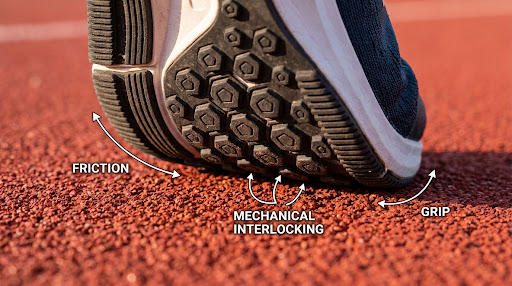 Physics • Friction
Why do sports shoes have treads?
Grooves interlock with surface irregularities to increase grip, helping prevent slips during rapid sprints.
Friction
 Monsoon road safety
Vehicle tyres on wet monsoon roads
Tyre channels move water away from the contact patch so the tyre keeps its grip on wet roads.
Fluid mechanics
 Thermodynamics & phase
Ice-skating's near-frictionless glide
Pressure under the narrow blade helps form a thin film of water that acts as a natural lubricant.
Pressure and melting
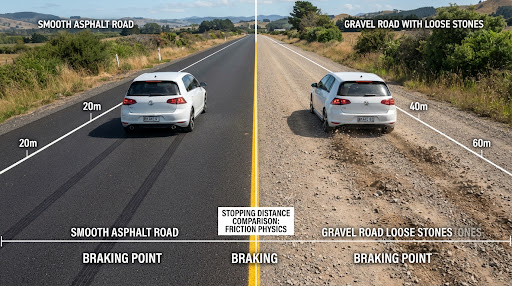 Work-energy theorem
Asphalt vs. gravel stopping distances
Use work done by friction to see why braking distances grow on loose gravel.
Work & energy
Currently in beta • Invite only
Don't Just Learn. Understand.
Build understanding that stays with you. Learn concepts. Ask questions. Practice without fear. Apply what you know. Keep growing.
- Grades 8–10
- CBSE & ICSE
- Science & Maths